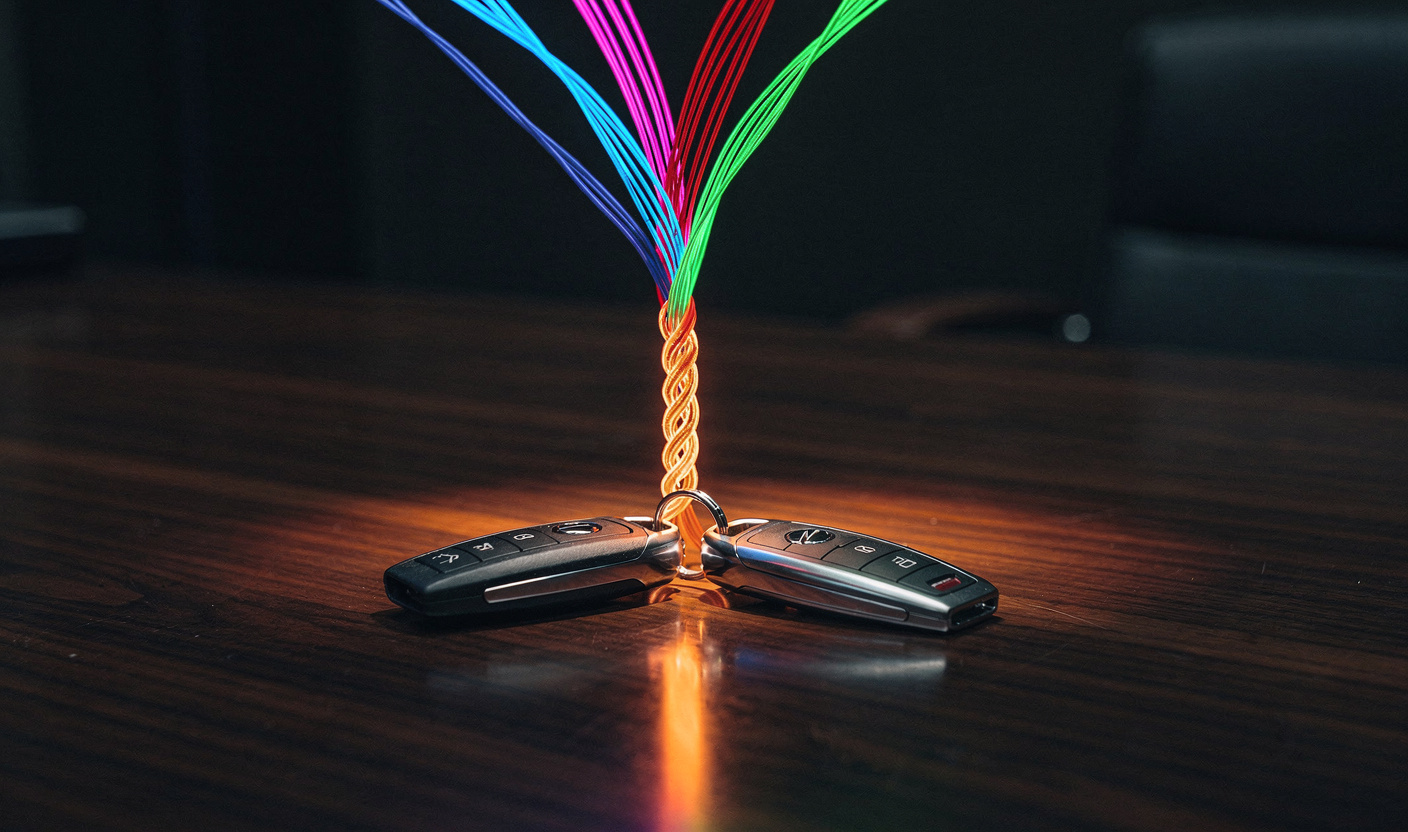
A dealership's text number is a customer relationship with a phone number attached. If a vendor filed the carrier registration, the vendor is the brand of record, and the store is a tenant on its own customer line.
Most GMs have never read the registration behind their store's text program. They assume it says the dealership's name. When the vendor filed it, it often says something else, and that gap decides who can move the number, who holds the consent record, and who answers when a regulator asks why a shopper got a text at 8:40 at night.
This is a data ownership problem wearing a compliance costume. The fix is simple to state and rarely implemented: register the number under the dealership's own legal identity.
Who Actually Owns a Dealership's Text Number When a Vendor Files the Registration?
The entity named on the carrier registration owns the program in every way that matters to the carriers. If the vendor is that entity, the dealership is a sub-user of the vendor's program. It cannot take the number to another provider without the vendor's cooperation, and it cannot show a carrier or a regulator that the program is its own.
That is the same structure the canon has argued about for years in ad accounts. An agency that opens the ad account in its own name holds the history, the audiences and the leverage. A text vendor that files under its own registration holds the same things for the customer line: the sending reputation, the opt-in history and the right to be the one the carrier talks to.
The dealership pays for the messages, takes the complaints and carries the legal exposure. The vendor holds the paperwork. That is renting your own customer line, and the rent comes due the day you want to leave.
What Does Carrier Registration Decide That the Dealer Never Sees?
Carrier registration for application-to-person texting asks who the sender is, what the program does, how people opt in and what the terms say. The answers are vetted before the number is allowed to send at scale. The brand on that filing is the identity the carriers judge.
When the brand is the dealership, the carrier is looking at a real franchise store with a business identity, a website and a privacy policy that describes the text program. When the brand is a vendor, the carrier is looking at the vendor, and the dealership's name is a field in a template.
The practical consequences show up late. A number that is filtered or suspended is the vendor's problem to resolve, on the vendor's timeline. A dealer that switches vendors cannot assume the number, the approved campaign or the sending history comes with it. A store that wants to know why its texts stopped arriving is asking a third party to read someone else's filing.
AUTONOMi's design registers each dealership's text number with US carriers under the dealership's own legal identity, using its EIN, business type and an authorized representative, with AUTONOMi filing and maintaining the registration as the dealer's agent.✓ Oct 26 The point is not that this is exotic. The point is that it is a choice, and most stores never knew it was one.
Why Do Quiet-Hour Statutes in Texas, Florida, Oklahoma and Washington Make This Worse?
The federal default is a calling window that most drip tools were built around. Several states set a stricter clock, and a tool that only knows the federal window will schedule texts the state treats as violations.

AUTONOMi's SMS quiet hours are state-aware for the states with verified stricter statutes on file: Texas runs 9am to 9pm Monday through Saturday and noon to 9pm on Sunday under SB 140.✓ Oct 26 Florida (FTSA), Oklahoma (OTSA) and Washington (RCW 19.158.110) each run 8am to 8pm.✓ Oct 26 Everywhere else the federal TCPA 8am to 9pm window applies.✓ Oct 26
Read that list as a dealer group with stores in more than one of those states. A single schedule built on the federal window is wrong in four places, and wrong in different directions: too late in Florida, Oklahoma and Washington, and blind to the Sunday rule in Texas. We covered the Texas clock in detail in our piece on whether your vendor is reading the statute.
Here is where registration ownership enters. If the vendor controls the registration and the sending logic, the dealership cannot inspect which clock was applied to which message. It is relying on a promise. If the number is the dealership's own, registered in its name and sent through a line the store can see, the store can ask a direct question and expect a direct record.
Can the Dealer Prove Consent If the Vendor Holds the Record?
Consent is the document that matters when a complaint arrives, and it has to be the dealership's. AUTONOMi requires an affirmative consent record for dealer-initiated one-off texts, either a submission-time SMS checkbox or a confirmed double opt-in, never just the absence of an opt-out.✓ Oct 26
The question for every store is where that record lives and who can produce it. A consent ledger inside a vendor's database is a record the dealership can request. A consent ledger kept per dealership and per number is a record the dealership owns. The difference is invisible until the day the vendor is slow to respond, or is no longer the vendor.
Opt-outs have the same shape. A shopper who texts STOP to the dealer's line expects the dealership to stop, across every tool that touches that shopper. AUTONOMi writes opt-outs from every surface to one shared do-not-contact ledger and checks it before every text and call the platform places, and an unreadable record holds the send rather than risking it.✓ Oct 26 A store whose opt-outs live in three vendors' systems is one export away from a text to someone who said stop.
What Should a Dealer Ask Its Text Vendor Before Renewing?
The questions are short, and the answers sort vendors quickly.

- Whose legal name is the brand on the carrier registration, and can I see the filing?
- If I leave, does the number and its approved campaign move with me?
- Which quiet-hour clock does each of my stores use, and where is that recorded?
- Where is my consent record, in what format, and can I export it today?
- Which page did the carrier vet as my privacy policy, and is it on my own domain?
A vendor that answers the first question with the dealership's name has nothing to hide. A vendor that answers with its own name has told you whose line it is.
The same logic applies to what happens after the first text. A shopper who replies at 11 p.m. is waiting to see whether anyone follows up at all, which is the argument in the 24/7 dealership is a reply schedule. A reply schedule only works if the line is yours and the clock is correct for the state the shopper is standing in.
The AUTONOMi Approach to Dealer-Owned Text Registration
At AUTONOMi the brand on the carrier registration is the dealership, and the number stays dark until the carriers verify the campaign.✓ Oct 26 The honest description is that the registration is the dealership's, filed by us as its agent, with carrier-required language drafted for the store's own privacy policy. We do not text under our own registration on a dealer's behalf.
Nothing is filed with the carriers, and no number is bought, until the dealership's own privacy policy carries the program.✓ Oct 26 AUTONOMi drafts the required language, the dealer sends it to its website provider with its own admins copied for approval, the provider appends it without editing anything existing, and AUTONOMi re-reads the published page and checks every required passage before filing.✓ Oct 26 The page the registry vets is the dealership's own, on the dealership's own domain.
The text program has its own consent page and Text Message Terms, presented in the dealership's name and carrying the same program terms its privacy policy states. One text, two places, never a second policy. Every consumer marketing text leaves from the dealership's own registered line through one sender, capped at four per number per rolling 30 days, and a store whose line is not live holds the text.✓ Oct 26
A consumer joins by the text-me web form or by texting SAVE to the dealer's number, and in both cases is enrolled only when the number itself replies YES.✓ Oct 26 No one is texted first. That is the claim, and it is deliberately narrower than what some vendors advertise. We name the covered states rather than promising every state law automatically, because the statutes we cite are the ones with verified rows on file, each added with a citation and never guessed.
Where Does Text Ownership Go From Here?
Carrier scrutiny will tighten, and states will keep writing their own clocks. Each change lands on whoever is named on the registration and whoever holds the consent record. Stores that own both will adapt by asking for a record. Stores that rent both will adapt by waiting for a vendor.
The dealer group that treats the text number as an asset, registered in its name, hosted on its domain and governed by a consent ledger it can export, loses nothing when a vendor relationship ends. Everyone else learns what they were renting on the way out. If you want the number registered in your dealership's name and the quiet-hour clock applied per state, sign up and see it on your own stack.