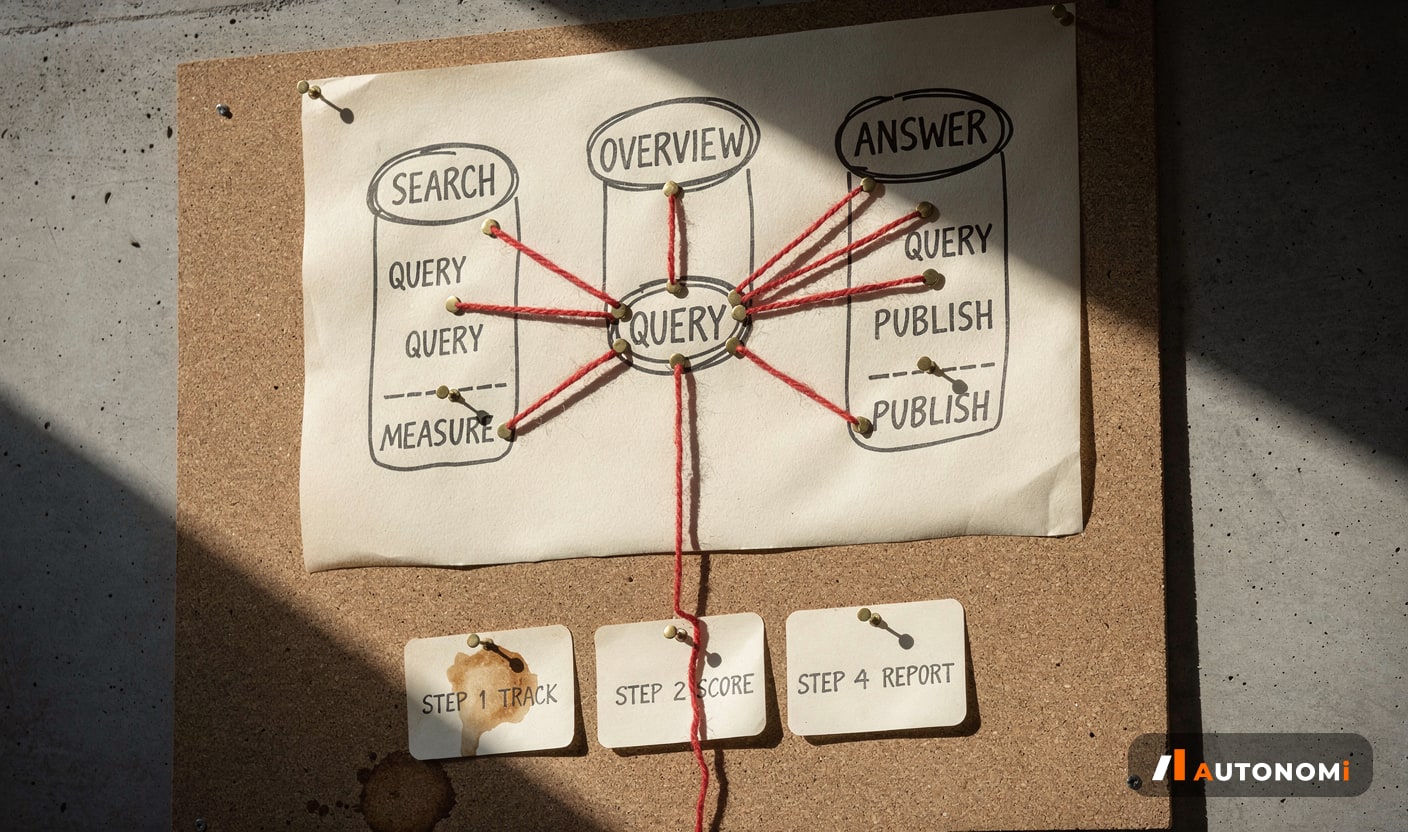
Ask a dealer which channel sold the car and you will get three answers: the agency's deck, the platform dashboards, and the sales manager's memory. None agree, and the disagreement is not a measurement problem. It is an identity problem. The click arrived carrying a name, and somewhere between the ad and the lead form the name was thrown away.
This post argues for a narrower and more honest standard than the industry sells. Tag the click at the moment the ad is built. Carry that tag into the lead. Let each platform report the conversions it can see. Then say out loud where the platform's knowledge ends and the CRM's begins. Anything blended past that point is a story, not a measurement.
How Can Dealers Attribute Sales Across Multiple Marketing Channels?
Start by splitting the question in two. The first half is which ad, on which platform, produced this visit and this lead. The second half is which lead became a delivered car. Different systems own each half, and most attribution failures come from pretending one system owns both.
The first half belongs to the ad stack. It can be answered with parameters on the landing URL, a conversion pixel, and a server-side copy of the same events. The second half belongs to the CRM and the desk, because that is where a sold deal is actually recorded. A platform cannot see a deal that closed on the showroom floor. AUTONOMi's dealer reports are built on the advertising platforms' own reported spend, clicks and conversions, and they report platform-attributed conversions, never retail units sold or gross. That is a limit, and we state it as one.
A dealer who holds that line gets something better than a blended number. They get a clean first half and an honest boundary where the second half begins.
Why Does the Click Lose Its Identity Before the Lead Lands?
Walk the path of a shopper. They tap a Meta ad on a phone, browse three vehicle pages, leave, search the dealer's name on Google two days later, and submit a form. The form lands in the CRM with a source of "website" or "internet lead." The tap that started it is gone.

That loss is rarely malicious. It is structural. Ad URLs are built by one person, landing pages are served by a website provider, forms post into a CRM that has its own source dropdown, and nobody owned the thread through all four. By the time the lead is entered, the only identity left is whatever a human typed or a default assigned.
Multi-touch models are usually sold as the cure. They are not. A model that apportions credit across touches can only work on touches that were recorded with an identity in the first place. Weighting a lost click is arithmetic on nothing. The fix sits upstream of the model: record the identity when the click is created, not when the report is assembled.
Why Is the Agency PDF the Loser?
The monthly agency report is the most expensive place to discover that nothing was tagged. It typically blends platform conversions, call counts and a retail claim nobody can trace into a single ROI line. The author of the deck has every incentive to make the blend look good and no way to show the join.
The test is simple. Ask the agency for one lead from last month, and the ad that produced it. If the answer is a slide instead of a record, the report is narrative. If the answer differs depending on whether you ask the agency, the platform, or the CRM, the report is not measuring anything the three systems share.
This is why the same argument we made about calculating marketing ROI by channel applies here: keep platform-reported spend and conversions per channel apart from units sold, and never let a deck merge them into a figure that cannot be audited. The PDF loses not because agencies are dishonest but because a blended number cannot be checked by anyone outside the blend.
What Does a Tagged Click Actually Carry Into the Lead?
A tagged click carries a short, consistent vocabulary: which campaign sent it. AUTONOMi uses its own atm_ attribution parameters, plus standard utm_ parameters on non-Google platforms, and at build they ride on Google campaigns as an atm_-only Final URL suffix, on Meta ads as url_tags, on TikTok ads baked into the landing URL, and on Microsoft Vehicle Ads feed URLs. Google is atm_-only because Google auto-tagging (gclid) already reports Google clicks to Google Analytics.
Be exact about the gaps, because a tag you assume is present is worse than one you know is missing. Native Microsoft Search builds do not carry a tracking suffix today, and already-live TikTok ads cannot be retro-tagged yet. On request, AEGIS applies tracking to an already-live Google, Microsoft Search or Meta campaign one campaign at a time, merged with whatever tracking the campaign already carries rather than replacing it.
Once the landing URL carries the tag, the rest is plumbing the dealer's own stack can do: read the parameters on arrival, store them with the session, and write them onto the form submission. The goal is that the lead record says where it came from in the same words the ad platform used. Where the tag is missing, the honest label is "unattributed," not a guess.
The same discipline matters after the form is submitted. Captured form leads are delivered to the dealer's CRM as ADF/XML 1.0 email to their lead-routing inbox, the automotive-standard lead path every dealer CRM ingests, with no third-party bridge. For a single-vehicle Spotlight ad, the lead arrives in the dealer's CRM as ADF/XML carrying the exact VIN and stock number. That is as close to unit-level identity as the ad side honestly gets.
Why Does the Browser Pixel Undercount, and What Does Server-Side Fix?
A pixel that fires in the shopper's browser is a request the shopper's browser can refuse. Privacy settings and script blockers drop some of those requests, and the platform never hears about the conversion. The ad worked; the report says it did not.
The remedy is to send the same event from a server as well, and to make sure the platform counts it once. For dealers with server-side tagging provisioned, conversions are additionally forwarded server-to-server from AUTONOMi's first-party tagging server to Meta's Conversions API, TikTok's Events API, native server-side Google Ads and the Microsoft UET Conversions API, deduplicated against the client pixel by a shared event id. The server-side path recovers conversions that client-side privacy and script blockers would otherwise drop.
Two caveats belong in the same breath. First, that path exists for dealers whose server-side tagging is provisioned, not for every account by default. Second, Microsoft's server-side path requires Microsoft's Conversions API access, which is in pilot, and until a dealer's token is provisioned the Microsoft forwarder is installed but inert. Saying so is the point. A measurement claim is only as strong as the list of places it does not hold.
Deduplication is the part vendors skip in the pitch. Send a pixel event and a server event without a shared id and the platform counts two conversions for one lead. Honest counts need one id on both copies, so the platform keeps one.
Where Does the CRM Take Over, and Where Should the Platform Report Stop?
The platform's report ends at the conversion it recorded: a form fill, a call, a click to a dealership page. The CRM's record begins at the lead and runs through appointment, write-up, deal and delivery. The seam between them is the lead's source field, and that field is only useful if the tag arrived intact.

Draw the line in writing. The ad stack answers: which campaign sent this lead, and what did it cost to get the conversion the platform counted. The CRM answers: did this lead show, did it close, and what did the deal gross. The sales process answers: how fast did a human respond. If the lead was slow to be answered, the ad did not fail, and the fix is not a new creative. That argument deserves its own read, and we made it in a post on naming the minute a lead waited, and again in a piece on the one number CRM software never prints.
Notice what this arrangement refuses to do. It does not claim a click-to-sold-unit pipeline the ad stack cannot see. AUTONOMi has no direct API connection into a dealer's CRM or DMS, so the sold-deal half of the story stays where the deal is recorded. A report that quietly pretends otherwise is inventing the join.
For the shopper who asks a question before any form exists, the lead has not started yet. We covered that earlier gap in why the lead is already too late at the form submit. Attribution that begins at the form begins late.
How AUTONOMi Solves This
AUTONOMi treats the click's identity as something written at build, not reconstructed at reporting time. When AEGIS builds Google campaigns, Meta ads, TikTok ads and Microsoft Vehicle Ads feeds, the atm_ parameters go on at build in the form each platform accepts. Where a surface cannot carry them, native Microsoft Search builds and live TikTok ads, we say so instead of implying coverage, and the tagging can be applied to live Google, Microsoft Search and Meta campaigns on request.
On the measurement plane, every dealer's published Tag Manager container is fire-tested on the real website: the six canonical conversions are injected in a headless browser, every ad-platform hit is captured and blocked so nothing is delivered, and the per-platform matrix is asserted against the dealer's own live IDs. That test confirms the container fires the right conversions to the right accounts. It does not audit the totals that later appear in a report, and we do not describe it that way. A nightly measurement-integrity audit also checks the live measurement plane, including spend-without-conversions liveness and click-linkage integrity, and dispatches a repair run when a finding will not converge.
Leads leave as ADF. A store can name more than one routing inbox, and can assign an inbox to one strategy, such as Spotlight leads to one CRM intake and everything else to another. For Meta lead capture, every CRM intake address receives a test lead before any shopper's lead is sent to it, and a bounce holds delivery, notifies the dealer, and replays the held leads once the address is re-confirmed. And the ad accounts, analytics properties and containers stay dealer-owned, with AEGIS working by delegated access the dealer can revoke.
What AUTONOMi does not do is claim to see past the CRM. The reports we produce state platform-attributed results as platform-attributed, and the sold-unit record stays with the dealer's own system.
What Happens When Attribution Stops Being a Debate?
The next argument inside dealer groups will not be about which model to apply. It will be about which stores can produce a lead with a name on its click and which cannot. Groups that can will move budget on evidence the platforms and the CRM both recognize. Groups that cannot will keep paying for a blended deck and arguing about it quarterly.
The work is unglamorous and it is mostly done at build: tag the click, keep one event id across pixel and server, hand the lead to the CRM in the standard format, and write down what the ad stack can and cannot see. If you want that thread running across your Google, Meta, TikTok and Microsoft accounts, sign up and connect your accounts to AUTONOMi and ask for the tagging coverage on every campaign before the next report is written.
Two caveats belong in the same breath. First, that path exists for dealers whose server-side tagging is provisioned, not for every account by default. Second, Microsoft made its Conversions API generally available on October 28, 2026, but it still needs a Conversions API authentication token for the dealer's UET tag, so the Microsoft forwarder stays installed but inert until that token is provisioned. Saying so is the point. A measurement claim is only as strong as the list of places it does not hold.